ROKAKIS NOT RUNNING FOR MAYOR: I just listened to Jim Rokakis on WCPN's "90.3 at 9", with Zack Schiller of Policy Matters, talking about the hospital "payment in lieu of taxes" issue.
Asked about his possible candidacy for mayor, Rokakis said he's decided not to run.
12.29.2004
HOSPITALS, TAXES AND POLITICS: Cuyahoga County Treasurer and Cleveland mayoral candidate (note: not any more) Jim Rokakis has an enviable knack for showing up in the media to talk about public policy ideas, rather than scandals or fights with other officeholders. But that doesn't mean he always avoids controversy.
A few months back some fur flew in the suburbs when Rokakis called for the consolidation of a few municipal library systems. (Ain't it amazing how parochial and un-regional those upper-income communities can be when it comes to their own civic institutions?) And yesterday he was in the PD raising an even more dangerous issue: The property taxes not paid by the county's two biggest employers, Cleveland Clinic and University Hospitals.
Rokakis' call for "payments in lieu of taxes" from these two institutions is backed up by two short studies he commissioned from Policy Matters, released December 17. If you care at all about local finances you should read them both, but here's the "money quote" from the second report, page 2:
In light of the City's permanent service cuts, the School District's ongoing financial emergency, Metrohealth's pleas for more county money for uninsured care -- and the fact that large numbers of Cleveland voters are among the poor and uninsured themselves, with no love for big rich hospital systems -- Rokakis has picked a pretty interesting issue to launch his mayoral campaign.
A few months back some fur flew in the suburbs when Rokakis called for the consolidation of a few municipal library systems. (Ain't it amazing how parochial and un-regional those upper-income communities can be when it comes to their own civic institutions?) And yesterday he was in the PD raising an even more dangerous issue: The property taxes not paid by the county's two biggest employers, Cleveland Clinic and University Hospitals.
Rokakis' call for "payments in lieu of taxes" from these two institutions is backed up by two short studies he commissioned from Policy Matters, released December 17. If you care at all about local finances you should read them both, but here's the "money quote" from the second report, page 2:
Both in the city and the county, the two nonprofit hospital systems, the Cleveland Clinic Health System and University Hospitals Health System, are the major owners of charitable-owned property. County-wide, they together account for at least $1.3 billion in such tax-exempt property, according to records supplied by the Cuyahoga County auditor and treasurer. This represents close to two-thirds of the tax-exempt charity holdings and 1.4 percent of all the real property, taxable and exempt, in Cuyahoga County. If these institutions paid taxes on all of their exempt real property in the county as it is now valued, local school districts and governments would receive more than $34 million a year in additional taxes.As the reports make clear, the tax-exempt status of most Clinic and UH medical facilities is based on their ostensible "charitable" purpose, and both systems are seeking exemption on this basis for even more of their properties (like some previously taxable suburban medical offices). So it's worth noting that the guys running these "charities", Clinic CEO Toby Cosgrove and UH CEO Tom Zenty, are each paid over a million dollars a year. (Cosgrove's package is more than $1.6 million.) And the Clinic, in particular, has taken heat from many directions for the small proportion of its resources devoted to charitable care -- including a national class action lawsuit filed in July.
In light of the City's permanent service cuts, the School District's ongoing financial emergency, Metrohealth's pleas for more county money for uninsured care -- and the fact that large numbers of Cleveland voters are among the poor and uninsured themselves, with no love for big rich hospital systems -- Rokakis has picked a pretty interesting issue to launch his mayoral campaign.
12.22.2004
PRESS SILENCE ON SUNOCO ENDS: After three months of silence, the Toledo Blade finally had an article yesterday on Ohio Citizen Action's fight to protect East Toledo residents' health surveys from a Sunoco subpoena.
If you wrote the Blade a letter, thank you!
If you wrote the Blade a letter, thank you!
CHECK THESE OUT...
Hotel Bruce has two excellent articles on Ohio City/Near West neighborhood development -- "Who can afford Ohio City?" by Marc Lefkowitz, and Lee Chilcote's look back at thirty years of organizing and development efforts that started in the Lorain Avenue Savings and Loan building at Lorain and Fulton. There's plenty to argue about in both pieces, but together they shed considerable light on the real, difficult issues of neighborhood work.
And Brewed Fresh Daily catches an enlightening piece from SmartMobs.com about tech-empowered strikers at a factory in China that supplies WalMart.
Hotel Bruce has two excellent articles on Ohio City/Near West neighborhood development -- "Who can afford Ohio City?" by Marc Lefkowitz, and Lee Chilcote's look back at thirty years of organizing and development efforts that started in the Lorain Avenue Savings and Loan building at Lorain and Fulton. There's plenty to argue about in both pieces, but together they shed considerable light on the real, difficult issues of neighborhood work.
And Brewed Fresh Daily catches an enlightening piece from SmartMobs.com about tech-empowered strikers at a factory in China that supplies WalMart.
12.21.2004
"DO-IT-YOURSELF ANTI-MUNICIPAL BROADBAND KIT": Esme Vos at MuniWireless has the goods on a piece of "model legislation" now being circulated by a Washington think tank with honchos from BellSouth and Verizon on its board.
A couple of days ago, MuniWireless also flagged Ohio House Bill 591, introduced in the General Assembly's waning days by Representative Thom Collier (GOP-Mount Vernon). It's not the same thing as Pennsylvania's House Bill 30 (as Harold Feld of Media Access Project explains at Wetmachine), and it was introduced too late to go anywhere in the session that just ended, but... it's one more reason to expect a serious legislative attack on city-sponsored broadband when the new session begins in January.
(Incidentally, for the last two years Rep. Collier has served as chairman of the House Economic Development and Technology Committee.)
And here, again from MuniWireless, is why this all matters to non-geeks in Cleveland: "Wireless broadband: Anti-poverty weapon".
A couple of days ago, MuniWireless also flagged Ohio House Bill 591, introduced in the General Assembly's waning days by Representative Thom Collier (GOP-Mount Vernon). It's not the same thing as Pennsylvania's House Bill 30 (as Harold Feld of Media Access Project explains at Wetmachine), and it was introduced too late to go anywhere in the session that just ended, but... it's one more reason to expect a serious legislative attack on city-sponsored broadband when the new session begins in January.
(Incidentally, for the last two years Rep. Collier has served as chairman of the House Economic Development and Technology Committee.)
And here, again from MuniWireless, is why this all matters to non-geeks in Cleveland: "Wireless broadband: Anti-poverty weapon".
12.17.2004
CAN'T MAKE THIS STUFF UP: Sunoco attorney in Toledo demands that Ohio Citizen Action members pay his legal fees.
While Sunoco attorney Louis Tosi has been trying to force Citizen Action to turn over confidential health interviews from neighbors of Sunoco's Toledo-area refinery, other lawyers at his own firm -- Shumaker, Loop and Kendrick -- recently convinced the Ohio Supreme Court to protect the "source confidentiality" of a Toledo radio news director who fed a sex rumor about a Toledo Blade reporter to the station's morning talk show host... who was then sued by the reporter for repeating it on the air.
As the Shumaker, Loop website proudly reports:
More of the gory details of the lawsuit can be found here.
So to sum up, here's the position of Mr. Tosi's law firm:
1) The right of a radio news director and talk show host to protect the source of a scurrilous sexual rumor about a rival reporter is absolute, and must be defended all the way up to the Supreme Court; but
2) The right of citizens who provide private medical information to a civic organization's health survey to have that information held in confidence is a "frivolous" claim, and the organization's efforts to defend that claim should be punished, financially and criminally.
You gotta have principles.
"Sunoco's Toledo attorney filed papers with a Toledo court on December 14, demanding that Ohio Citizen Action members pay his legal fees. Louis Tosi had previously subpoenaed Citizen Action demanding that the organization turn over to him all health questionnaires, including personal medical information, about Sunoco neighbors, with their names and addresses."MR. TOSI, CALL YOUR OFFICE: DOUBLE STANDARD AT SHUMAKER, LOOP
While Sunoco attorney Louis Tosi has been trying to force Citizen Action to turn over confidential health interviews from neighbors of Sunoco's Toledo-area refinery, other lawyers at his own firm -- Shumaker, Loop and Kendrick -- recently convinced the Ohio Supreme Court to protect the "source confidentiality" of a Toledo radio news director who fed a sex rumor about a Toledo Blade reporter to the station's morning talk show host... who was then sued by the reporter for repeating it on the air.
As the Shumaker, Loop website proudly reports:
TOM PLETZ of the Toledo office spoke at the Toledo Bar Association "Media Law Seminar" November 8, 2004 on the subject of the Ohio "reporter's shield" law, which protects news reporters from being required to disclose the identitiy of their news sources in court.The case (Svoboda v Clear Channel Communications, Inc.) was summarized here last March, when the Sixth District Court of Appeals upheld a Lucas County Common Pleas Court order telling WVKS news director Tricia Tischler to reveal the name of her source for the rumor about Blade reporter Sandra Svoboda ... essentially because it wasn't actually "news". That's the decision that Shumaker, Loop lawyers just got overturned.
Tom and NEEMA BELL (Toledo) obtained a ruling from the Supreme Court of Ohio November 1, 2004, which protected a Clear Channel Broadcasting radio station news director from disclosing the identity of a news source who had provided a tip. The Supreme Court merit decision without opinion effectively extinguished an earlier adverse Sixth District Court of Appeals' opinion which had construed the statute quite narrowly, and which would have required the Clear Channel news reporter to name her source.
More of the gory details of the lawsuit can be found here.
So to sum up, here's the position of Mr. Tosi's law firm:
1) The right of a radio news director and talk show host to protect the source of a scurrilous sexual rumor about a rival reporter is absolute, and must be defended all the way up to the Supreme Court; but
2) The right of citizens who provide private medical information to a civic organization's health survey to have that information held in confidence is a "frivolous" claim, and the organization's efforts to defend that claim should be punished, financially and criminally.
You gotta have principles.
12.13.2004
JUDGE SAYS CONSUMER GROUP MUST TURN OVER CONFIDENTIAL HEALTH SURVEYS FROM TOLEDO REFINERY NEIGHBORS TO SUNOCO; MEDIA IS SILENT
You know how, when reporters are told by prosecutors and judges that they have to name their sources or go to jail, it's immediately a national news story? Even when the reporter is protecting a criminal -- like say, a source who leaked classified information to damage a political opponent?
Hold that thought while I tell you a story.
Since August, Ohio Citizen Action, a nonprofit consumer and environmental action group, has been fighting a subpoena in Lucas County (Toledo) Common Pleas Court. The subpoena demands that OCA turn over (among other things) copies of personal health surveys, filled out by 473 neighbors of Sunoco's MidAmerica refinery, to attorneys for Sunoco. OCA has been ordered by Judge Ruth Ann Franks to comply. OCA says the information was collected in confidence and they can't turn it over unless individual respondents give their permission. If they don't, OCA staff and leaders face contempt of court charges and possible jail time.
Haven't heard about this? There's a reason for that. The media is ignoring the story.
The surveys were collected in August from residents of the low-income East Toledo neighborhood near the Oregon, Ohio refinery as part of an ongoing OCA "Good Neighbor Campaign" to reduce the facility's toxic emissions. They contain respondents' names, addresses, and personal health information. The compiled results were released to the media and sent to the Toledo-Lucas County health commissioner with a request for a formal public investigation into the serious, recurring health problems reported by neighborhood residents.
The subpoena was issued to OCA by Sunoco attorney Louis Tosi in connection with a class action lawsuit filed by fifteen neighbors of the refinery in March. OCA isn't a party to the suit, didn't organize support for it, and has had minimal contact with the plaintiffs' attorney. Nonetheless, Tosi's subpoena demands that OCA turn over virtually every scrap of paper and computer file in its possession that has anything to do with the refinery... including the 473 original survey forms.
The whole history of the campaign and the subpoena (from OCA's viewpoint) can be read here. But here's the bottom line:
On November 22, Judge Franks denied OCA's motion to quash Sunoco's subpoena and ordered the organization to turn over the survey forms within fourteen days. That clock ran out on December 6.
OCA has asked for time to contact the individual respondents and ask for their permission. Without that permission, OCA says it can't comply with the judge's order. Contempt of court citations are the likely result.
Now here's the weird part. This story was last covered by the Toledo Blade on September 9, three months ago. Since then, despite numerous OCA press releases, there's been no media coverage of any kind -- not by the Blade, or Toledo television, or the AP, or the Cleveland Plain Dealer, or the Columbus Dispatch, or NPR. Nobody. Nothing. Total silence.
Try to imagine that it was a reporter or a newspaper in this situation -- facing jail time for protecting the confidentiality of low-income residents who filled out a form describing their personal health problems. Would there be media attention? The only question would be the size of the headline on the front page of USA Today.
Ohio Citizen Action needs your help in this fight. I think they deserve it. (Disclosure: I worked for OCA throughout the 1980s and my daughter works there now... which is the only reason I know about this.) Here's what you can do:
First, send an email or letter to Sunoco CEO John Drosdick asking him to contact his lawyer Louis Tosi and get the subpoena withdrawn.
Second, write a letter to the Toledo Blade asking why this story isn't being covered.
And third, spread the word. If you're a blogger, please blog this story. I don't give a crap if you link here or not... feel free to write it up yourself and take credit, but please get this out into blogspace!
Thanks.
You know how, when reporters are told by prosecutors and judges that they have to name their sources or go to jail, it's immediately a national news story? Even when the reporter is protecting a criminal -- like say, a source who leaked classified information to damage a political opponent?
Hold that thought while I tell you a story.
Since August, Ohio Citizen Action, a nonprofit consumer and environmental action group, has been fighting a subpoena in Lucas County (Toledo) Common Pleas Court. The subpoena demands that OCA turn over (among other things) copies of personal health surveys, filled out by 473 neighbors of Sunoco's MidAmerica refinery, to attorneys for Sunoco. OCA has been ordered by Judge Ruth Ann Franks to comply. OCA says the information was collected in confidence and they can't turn it over unless individual respondents give their permission. If they don't, OCA staff and leaders face contempt of court charges and possible jail time.
Haven't heard about this? There's a reason for that. The media is ignoring the story.
The surveys were collected in August from residents of the low-income East Toledo neighborhood near the Oregon, Ohio refinery as part of an ongoing OCA "Good Neighbor Campaign" to reduce the facility's toxic emissions. They contain respondents' names, addresses, and personal health information. The compiled results were released to the media and sent to the Toledo-Lucas County health commissioner with a request for a formal public investigation into the serious, recurring health problems reported by neighborhood residents.
The subpoena was issued to OCA by Sunoco attorney Louis Tosi in connection with a class action lawsuit filed by fifteen neighbors of the refinery in March. OCA isn't a party to the suit, didn't organize support for it, and has had minimal contact with the plaintiffs' attorney. Nonetheless, Tosi's subpoena demands that OCA turn over virtually every scrap of paper and computer file in its possession that has anything to do with the refinery... including the 473 original survey forms.
The whole history of the campaign and the subpoena (from OCA's viewpoint) can be read here. But here's the bottom line:
On November 22, Judge Franks denied OCA's motion to quash Sunoco's subpoena and ordered the organization to turn over the survey forms within fourteen days. That clock ran out on December 6.
OCA has asked for time to contact the individual respondents and ask for their permission. Without that permission, OCA says it can't comply with the judge's order. Contempt of court citations are the likely result.
Now here's the weird part. This story was last covered by the Toledo Blade on September 9, three months ago. Since then, despite numerous OCA press releases, there's been no media coverage of any kind -- not by the Blade, or Toledo television, or the AP, or the Cleveland Plain Dealer, or the Columbus Dispatch, or NPR. Nobody. Nothing. Total silence.
Try to imagine that it was a reporter or a newspaper in this situation -- facing jail time for protecting the confidentiality of low-income residents who filled out a form describing their personal health problems. Would there be media attention? The only question would be the size of the headline on the front page of USA Today.
Ohio Citizen Action needs your help in this fight. I think they deserve it. (Disclosure: I worked for OCA throughout the 1980s and my daughter works there now... which is the only reason I know about this.) Here's what you can do:
First, send an email or letter to Sunoco CEO John Drosdick asking him to contact his lawyer Louis Tosi and get the subpoena withdrawn.
Second, write a letter to the Toledo Blade asking why this story isn't being covered.
And third, spread the word. If you're a blogger, please blog this story. I don't give a crap if you link here or not... feel free to write it up yourself and take credit, but please get this out into blogspace!
Thanks.
12.09.2004
12.08.2004
WAL-MART ON THE CUYAHOGA: So now it turns out that Steelyard Commons, the big inner-city mall development a few blocks upstream from ISG's West Side mill, may well be anchored by a Wal-Mart... maybe even Northeast Ohio's first Supercenter.
Funny how this wasn't mentioned a few months ago, when the great new project was rolled out to delighted squeals at City Hall. Funny how it also wasn't mentioned in October, when the Planning Commission gave Steelyard a thumbs-up in a "design review" process with no tenants identified.
I could start reciting all the downsides of the Wal-Mart scenario, but Alison Grant's article does a pretty good job of that, so instead I'm just going with a prediction:
Unless it comes with unprecedented labor and community protection agreements (and I stress the word unprecedented, as in "highly unlikely"), a Wal-Mart in Steelyard Commons will become one of the most important issues in the mayoral election next year and may well cost Jane Campbell a second term.
You read it here first.
HOW MANY OF ME ARE THERE? An email this morning from Jeff Sugalski at CSU's Neighborhood Link:
It does make me wonder, though: If the Campbell Administration, which has embraced the Social Compact findings, really thinks we have a population approaching 600,000 people, why aren't they loudly demanding an immediate increase in our "official" body count for purposes of Federal funding formulas... like for the Community Development Block Grant allocation? Seems like an undercount equal to the population of Youngstown is a pretty big deal.
What am I missing?
FAIRNESS AND BALANCE: Okay, since the last two entries are somewhat snarky toward the Campbell Administration, I've got to tip my hat in the Mayor's direction for two pieces of positive news:
First, while I'm one of the many local citizens who find the return of the Convention Center issue profoundly depressing, I'm glad to see Campbell staking out an early position for renovating and expanding the existing place, instead of wandering back into the swamp created by Cleveland Tomorrow and Forest City in the last go-round. The only way to keep this thing from turning into an election-year monster is to set some reasonable limits, make clear to Cleveland voters what you're doing, and stick to it. Good move, Mayor.
And a big round of applause for the Administration's dogged effort to preserve our anti-predatory lending ordinance against state pre-emption, which won an interim victory in a state appeals court last week. This fight is about more than protecting homeowners from financial victimization, though that's a plenty good enough reason to pursue it. It's also about protecting Cleveland's battered Home Rule rights from a legislature eager to eviscerate them, any time a corporate interest (in this case, the banking industry) asks them to. Once again -- good work, Mayor. Keep it up.
Funny how this wasn't mentioned a few months ago, when the great new project was rolled out to delighted squeals at City Hall. Funny how it also wasn't mentioned in October, when the Planning Commission gave Steelyard a thumbs-up in a "design review" process with no tenants identified.
I could start reciting all the downsides of the Wal-Mart scenario, but Alison Grant's article does a pretty good job of that, so instead I'm just going with a prediction:
Unless it comes with unprecedented labor and community protection agreements (and I stress the word unprecedented, as in "highly unlikely"), a Wal-Mart in Steelyard Commons will become one of the most important issues in the mayoral election next year and may well cost Jane Campbell a second term.
You read it here first.
HOW MANY OF ME ARE THERE? An email this morning from Jeff Sugalski at CSU's Neighborhood Link:
NeighborhoodLink is the exclusive online home of the Cleveland Neighborhood Market Drilldown Study conducted by Social Compact!...You might remember that this is the study released with great fanfare in November that claims to prove the city of Cleveland has 100,000-plus more residents than shown by the U.S. Census... and also implies that our average income is even lower than the Census told us. This is supposed to be good news for retail development in the city -- which makes sense, I guess, if the retail you have in mind is Wal-Mart.
If you haven't heard about it, the Cleveland Neighborhood Market Drilldown was designed to provide the city, the local business community, and Cleveland neighborhoods with a unique set of dependable business-oriented data and market insights that cannot be accessed through traditional market sources. It aims to help fuel the flow of private capital by supporting informed business decision-making for future investment in Cleveland's inner city and undervalued neighborhoods.
You can visit the Cleveland Neighborhood Market Drilldown Study website on NeighborhoodLink and see what it has to offer at http://www.nhlink.net/socialcompact/.
It does make me wonder, though: If the Campbell Administration, which has embraced the Social Compact findings, really thinks we have a population approaching 600,000 people, why aren't they loudly demanding an immediate increase in our "official" body count for purposes of Federal funding formulas... like for the Community Development Block Grant allocation? Seems like an undercount equal to the population of Youngstown is a pretty big deal.
What am I missing?
FAIRNESS AND BALANCE: Okay, since the last two entries are somewhat snarky toward the Campbell Administration, I've got to tip my hat in the Mayor's direction for two pieces of positive news:
First, while I'm one of the many local citizens who find the return of the Convention Center issue profoundly depressing, I'm glad to see Campbell staking out an early position for renovating and expanding the existing place, instead of wandering back into the swamp created by Cleveland Tomorrow and Forest City in the last go-round. The only way to keep this thing from turning into an election-year monster is to set some reasonable limits, make clear to Cleveland voters what you're doing, and stick to it. Good move, Mayor.
And a big round of applause for the Administration's dogged effort to preserve our anti-predatory lending ordinance against state pre-emption, which won an interim victory in a state appeals court last week. This fight is about more than protecting homeowners from financial victimization, though that's a plenty good enough reason to pursue it. It's also about protecting Cleveland's battered Home Rule rights from a legislature eager to eviscerate them, any time a corporate interest (in this case, the banking industry) asks them to. Once again -- good work, Mayor. Keep it up.
12.03.2004
WIRELESS PHILADELPHIA STORY CONTINUED: Lots of discussion out there on the issues raised by Pennsylvania House Bill 30 and the municipal wifi/broadband movement exemplified by Wireless Philadelphia.
Steve Goldberg links to unhappy comments on the Pennsylvania legislation by Sasha Meinrath, who links in turn to MuniWireless.
Here's internet.com on the buzz at the WiFi Planet conference.
And here's the Philadelphia Inquirer's business columnist Andrew Cassell, who didn't like the idea of Wireless Philadelphia when the mayor proposed it, having some second thoughts in the light of Verizon's attempt to squash it.
Chris Seper, reacting to my post yesterday, says:
So the argument in Pennsylvania isn't really about government vs. private. It's about whether local governments can act effectively to create alternatives to existing telecoms' market dominance, when their obsolete infrastructures -- and entrenched interests -- become obstacles to community innovation.
Steve Goldberg links to unhappy comments on the Pennsylvania legislation by Sasha Meinrath, who links in turn to MuniWireless.
Here's internet.com on the buzz at the WiFi Planet conference.
And here's the Philadelphia Inquirer's business columnist Andrew Cassell, who didn't like the idea of Wireless Philadelphia when the mayor proposed it, having some second thoughts in the light of Verizon's attempt to squash it.
Chris Seper, reacting to my post yesterday, says:
A source of mine at Case Western Reserve University once told me that a municipal network would never truly compete with a private provider like SBC. He compared it in some ways to bottled water versus water from the tap. A municipal Wi-Fi network (the tap water) would be slower, include a stringent filter to block a host of Web sites, and wouldn't quickly adjust for the number of users in an area (another issue that would effect Internet quality). Meanwhile, a private Internet service provider could guarantee faster and unfettered Internet use with additional services as well.While I think the generalizations here about the quality of municipal wireless presume too much, the basic point -- that public and private network development aren't necessarily in conflict -- is accurate. After all, One Cleveland's nonprofit/public network may be costing SBC some business, but it's creating a market for Cisco and IBM. And there's a good chance that the planned Philadelphia system -- and others like it -- will be implemented in partnership with private wireless vendors.
So the argument in Pennsylvania isn't really about government vs. private. It's about whether local governments can act effectively to create alternatives to existing telecoms' market dominance, when their obsolete infrastructures -- and entrenched interests -- become obstacles to community innovation.
12.01.2004
PHILLY WIRELESS OUTLOBBIES VERIZON, BUT WHAT ABOUT OTHER CITIES? The City of Philadelphia has cut a special deal to sidestep a legal veto of its planned citywide wi-fi system by Verizon. But the bill just signed by Pennsylvania's Governor gives private telecom firms "wi-fi veto power" over every other municipality in the state. Chris Seper links to a long Washington Post summary of the Pennsylvania outcome. Here's the Philadelphia Inquirer story.
I talked earlier with Ed Schwartz, the Wireless Philadelphia committee member who, along with city IT chief Dianah Neff, led the fight to save the city's plan from legislative extinction. Ed's read on the situation is that "the Philadelphia exception" will make it much more difficult for Verizon and other private telecoms to veto municipal initiatives throughout the state. After all, how do you tell Pittsburgh or Reading that you won't permit them to do what Philadelphia is doing?
Besides, the new legislation exempts municipal systems that are already up and running by January 1, 2006... so its immediate impact could be to make 2005 a very good year for wi-fi system architects and equipment vendors throughout Pennsylvania.
Two other results seem certain: First, Philadelphia's wi-fi system is going to happen; and second, legislation like Pennsylvania's will soon be moving through committee in dozens of state legislatures, including Ohio's.
Chris' piece, echoing a recent One Cleveland blog entry by Lev Gonick, says that community broadband in northeast Ohio may be sheltered from these attacks by One Cleveland's unique public/nonprofit partnership. Lev writes:
But the issue gets more difficult when we start thinking about systems to get robust broadband (like 5 to 10 mbs standard 802.11(b) service, or the 50 mbs access now available on the Case campus) to lots of city households and small businesses on an affordable, sustainable basis. Under current law, for example, there's nothing stopping Cleveland Public Power from laying out a fiber network through its substations (actually, it already has one) and then providing wireless broadband service to the surrounding neighborhoods very cheaply. Ditto for the Cleveland Public Schools, or the library system. But such a system, including access to the Internet through One Cleveland or another carrier, might be too expensive to simply offer for free -- there might have to be either a small regular user charge or a significant subsidy from some other public funding pot. If there's a charge and the sponsor is a public entity, a Pennsylvania-style law would give a veto to SBC, whether the public entity gets its bandwidth from One Cleveland or elsewhere.
I think we might not be very far from considering this kind of option -- maybe even in the context of City elections next year. And certainly a role for City government in supporting neighborhood wi-fi initiatives will be on the table very soon. So the spread of Pennsylvania HB30-style legislation needs to be watched carefully by Clevelanders who don't want our city to be prevented from leapfrogging the digital divide, and moving aggressively -- and together -- into the new economy.
I talked earlier with Ed Schwartz, the Wireless Philadelphia committee member who, along with city IT chief Dianah Neff, led the fight to save the city's plan from legislative extinction. Ed's read on the situation is that "the Philadelphia exception" will make it much more difficult for Verizon and other private telecoms to veto municipal initiatives throughout the state. After all, how do you tell Pittsburgh or Reading that you won't permit them to do what Philadelphia is doing?
Besides, the new legislation exempts municipal systems that are already up and running by January 1, 2006... so its immediate impact could be to make 2005 a very good year for wi-fi system architects and equipment vendors throughout Pennsylvania.
Two other results seem certain: First, Philadelphia's wi-fi system is going to happen; and second, legislation like Pennsylvania's will soon be moving through committee in dozens of state legislatures, including Ohio's.
Chris' piece, echoing a recent One Cleveland blog entry by Lev Gonick, says that community broadband in northeast Ohio may be sheltered from these attacks by One Cleveland's unique public/nonprofit partnership. Lev writes:
This brings me to the Philadelphia story. When the AP wire service first ran the story on that City's ambitious effort, David Caruso from AP contacted me. I outlined that OneCleveland, in contrast to a city-centered strategy like Philadelphia, was actually a community network. OneCleveland has subscribers, including a number of cities. This is only one of the major differences. In OneCleveland, many subscribers have, or are thinking about, enabling free wireless services to enable important public policy priorities within the unregulated spectrum known to support WiFi. This is very different than going into business to develop a revenue model for public wireless services.It's hard to say how true this might be. Certainly One Cleveland has done a brilliant job of putting NEO "ahead of the curve", as Lev's title says,in deploying very big bandwidth for government and nonprofit users. (And let me stress that Lev deserves huge credit for conceiving and pulling this off.) It's also true that, to the extent One Cleveland customers including cities, schools and libraries use that bandwidth as backhaul for free wi-fi service to their constituents or neighbors -- as Case now does for its guests -- a law like Pennsylvania's wouldn't affect them.
But the issue gets more difficult when we start thinking about systems to get robust broadband (like 5 to 10 mbs standard 802.11(b) service, or the 50 mbs access now available on the Case campus) to lots of city households and small businesses on an affordable, sustainable basis. Under current law, for example, there's nothing stopping Cleveland Public Power from laying out a fiber network through its substations (actually, it already has one) and then providing wireless broadband service to the surrounding neighborhoods very cheaply. Ditto for the Cleveland Public Schools, or the library system. But such a system, including access to the Internet through One Cleveland or another carrier, might be too expensive to simply offer for free -- there might have to be either a small regular user charge or a significant subsidy from some other public funding pot. If there's a charge and the sponsor is a public entity, a Pennsylvania-style law would give a veto to SBC, whether the public entity gets its bandwidth from One Cleveland or elsewhere.
I think we might not be very far from considering this kind of option -- maybe even in the context of City elections next year. And certainly a role for City government in supporting neighborhood wi-fi initiatives will be on the table very soon. So the spread of Pennsylvania HB30-style legislation needs to be watched carefully by Clevelanders who don't want our city to be prevented from leapfrogging the digital divide, and moving aggressively -- and together -- into the new economy.
11.30.2004
WOULD YOU HIRE THESE GUYS? It's now fairly evident that the Cuyahoga County Board of Elections screwed up its responsibilities in the November election to the extent that hundreds, if not thousands, of legitimate votes were not included in the total certified yesterday to the Secretary of State.
At the two-hour hearing yesterday prior to certification, the Voter Registration Coalition documented nearly 500 voters who were properly registered, showed up at the polls, but were then forced to use provisional ballots and subsequently excluded from the final count.
Nonetheless, the Board certified the results unanimously. According to the PD story, they characterized the problems with the count as "minimal".
Minimal? If you ran a company where the people in charge took orders and money from five hundred customers that you knew about (and probably lots more you didn't), failed to ship their orders, and then failed to make good on them when challenged, would you consider that a "minimal" problem? If you were one of those customers -- one who had stood in line in the rain for an hour or two to place that order -- would you consider the company's failure to deliver or rectify your order a "minimal" problem?
Board of Elections Director Michael Vu got lots of media after Election Day bragging about how well his operation performed. The reporters who carried this BS now have an obligation to go out and find some of the 500 documented disenfranchised voters, and ask them for an assessment of Vu's performance.
My assessment? Either Vu and his Board members -- Republican county chairman Robert Bennett and three others, all appointed by Bush campaign honcho Ken Blackwell -- have deliberately conspired to sideline thousands of voters in Cuyahoga County, or (more likely) they're just incompetent and irresponsible. In either case, they're unfit for their jobs and should be fired before they do any more damage.
At the two-hour hearing yesterday prior to certification, the Voter Registration Coalition documented nearly 500 voters who were properly registered, showed up at the polls, but were then forced to use provisional ballots and subsequently excluded from the final count.
Nonetheless, the Board certified the results unanimously. According to the PD story, they characterized the problems with the count as "minimal".
Minimal? If you ran a company where the people in charge took orders and money from five hundred customers that you knew about (and probably lots more you didn't), failed to ship their orders, and then failed to make good on them when challenged, would you consider that a "minimal" problem? If you were one of those customers -- one who had stood in line in the rain for an hour or two to place that order -- would you consider the company's failure to deliver or rectify your order a "minimal" problem?
Board of Elections Director Michael Vu got lots of media after Election Day bragging about how well his operation performed. The reporters who carried this BS now have an obligation to go out and find some of the 500 documented disenfranchised voters, and ask them for an assessment of Vu's performance.
My assessment? Either Vu and his Board members -- Republican county chairman Robert Bennett and three others, all appointed by Bush campaign honcho Ken Blackwell -- have deliberately conspired to sideline thousands of voters in Cuyahoga County, or (more likely) they're just incompetent and irresponsible. In either case, they're unfit for their jobs and should be fired before they do any more damage.
11.25.2004
ONE CLEVELAND, THE CITY AND WIFI: After covering the City of Cleveland's official hookup with One Cleveland last week, Chris Seper blogs:
To get back to One Cleveland and our City government, Chris' blog entry has one other piece of news:
The concept of free, citywide Wi-Fi service has slowly been de-emphasized in the evolution of OneCleveland. At first, some members used to talk of creating a vast, free Wi-Fi network that would give home access to every Clevelander. Others said they wanted to build a Wi-Fi corridor stretching from Case Western Reserve University to downtown, sprinkling large swaths of Wi-Fi access throughout the region.Hmmm. Well, if you want to see a city taking a serious look at community-wide wifi, Philadelphia is moving right along. The mayor's Wireless Philadelphia Executive Committee held a town meeting on the subject two weeks ago and put the whole two hours up as a webcast. The setting, the participants and the discussion are different from what we're used to around here -- I strongly recommend taking a peek. (The guy on the panel doing all the talking is my old friend and former co-worker Ed Schwartz of Neighborhoods Online.)
At the news conference Thursday, Mayor Campbell said Wi-Fi was something Cleveland would consider down the road. When I discussed Wi-Fi proliferation with Scott Rourke, OneCleveland's president, he said his organization enables municipalities by providing wired high-speed networks but that it's up to the municipalities to determine how to use them.
To get back to One Cleveland and our City government, Chris' blog entry has one other piece of news:
The mayor also said the city would flow high-speed service into community tech centers, which, coupled with efforts to create a standard computer literacy certification, would help raise the tech IQ of the city.Now that's what I'm talkin about...
11.23.2004
PUBLIC POWER PRICE DROPS... FOR NOW: My latest bill from Cleveland Public Power held a pleasant surprise. Our average kilowatt-hour cost was under ten cents... the lowest it's been since December 2000!
The bill would normally have been a little lower this month because we're back in Winter rate season. But the unexpected change was a drop in the "energy adjustment charge" -- the part of the bill that fluctuates monthly with CPP's cost of purchased power -- from four and a half cents per kwh, where it's been all Summer, to 2.7 cents. Sha-zam! My bill for about 500 kwh got $8 cheaper, and I owe CPP about 10% less than a CEI customer with the same usage.
The "EAC", which is broken out on the bill, is a very big factor in CPP's monthly charges because the system gets virtually all of its power supply from other utilities, generating only a thin margin of its own peak usage with some gas turbines. To get an idea of the scale of this cut in Public Power's EAC, take a look at this chart:
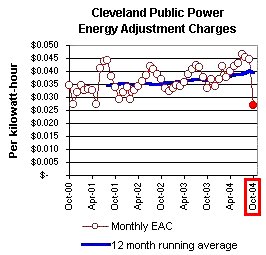
The red dot dangling at the right end of the graph line is the EAC for October. A big dropoff, yes? Sort of like the price of unleaded regular going back to $1.40 a gallon.
But just as the price of gasoline is only part of the cost of running your car, the cost of purchased power is only part of CPP's rates. Taking a cent and a half off the EAC still leaves Public Power customers paying a Winter rate of 9.7 cents a kilowatt-hour (10.9 cents in the Summer). While that's noticeably cheaper than CEI and its First Energy partners, Ohio Edison and Toledo Edison, it's still more expensive than any other private or municipal electric company in Ohio.
And it probably won't last very long.
I called Public Power yesterday and asked to speak with someone who could explain why their October EAC was so much lower, and what consumers can look forward to. I ended up leaving a message for James Quayle, whose title (I think) is CPP's Deputy Commissioner for Finance. A few minutes later the phone rang. On the other end was Julius Ciaccia, the City's Public Utilities Director, along with Quayle and his boss, CPP Commissioner James Majer. I guess getting quoted in Crain's raises your profile. (Actually they seem to have asked around and were told I'm not a nut case, which is gratifying.)
I learned several things from the call, which I'll try to follow up and share, but here are the main things Quayle and Majer told me about the October price cut:
The CPP managers promised to meet with me soon to talk more about the system's rates and other issues, short and long term. I'll let you know what else I learn.
The bill would normally have been a little lower this month because we're back in Winter rate season. But the unexpected change was a drop in the "energy adjustment charge" -- the part of the bill that fluctuates monthly with CPP's cost of purchased power -- from four and a half cents per kwh, where it's been all Summer, to 2.7 cents. Sha-zam! My bill for about 500 kwh got $8 cheaper, and I owe CPP about 10% less than a CEI customer with the same usage.
The "EAC", which is broken out on the bill, is a very big factor in CPP's monthly charges because the system gets virtually all of its power supply from other utilities, generating only a thin margin of its own peak usage with some gas turbines. To get an idea of the scale of this cut in Public Power's EAC, take a look at this chart:
The red dot dangling at the right end of the graph line is the EAC for October. A big dropoff, yes? Sort of like the price of unleaded regular going back to $1.40 a gallon.
But just as the price of gasoline is only part of the cost of running your car, the cost of purchased power is only part of CPP's rates. Taking a cent and a half off the EAC still leaves Public Power customers paying a Winter rate of 9.7 cents a kilowatt-hour (10.9 cents in the Summer). While that's noticeably cheaper than CEI and its First Energy partners, Ohio Edison and Toledo Edison, it's still more expensive than any other private or municipal electric company in Ohio.
And it probably won't last very long.
I called Public Power yesterday and asked to speak with someone who could explain why their October EAC was so much lower, and what consumers can look forward to. I ended up leaving a message for James Quayle, whose title (I think) is CPP's Deputy Commissioner for Finance. A few minutes later the phone rang. On the other end was Julius Ciaccia, the City's Public Utilities Director, along with Quayle and his boss, CPP Commissioner James Majer. I guess getting quoted in Crain's raises your profile. (Actually they seem to have asked around and were told I'm not a nut case, which is gratifying.)
I learned several things from the call, which I'll try to follow up and share, but here are the main things Quayle and Majer told me about the October price cut:
1) CPP gets its purchased power from established contracts with nine other utilities, one of which is American Electric Power. (They don't buy power on short term "spot" contracts.)(Of course this doesn't explain why the EAC has been rising steadily for years -- see the "12 month running average" line on the chart above. That's a question for future discussion.)
2) During the last few months, their average power cost was pushed up because electricity sales were lower than expected. Power contracts involve fixed as well as variable charges. CPP's summer contract with AEP, for example, obligates the City to pay for a certain minimum power load whether it's fully used or not. Because the summer wasn't very hot, CPP sold less electricity than it projected, so those fixed charges were distributed among fewer kilowatt-hours and had a bigger price impact than they expected. When the summer season ended in October, contract obligations lined up better with sales, CPP was able to use its cheapest sources, and the average cost came down a lot -- hence a much lower EAC on my November bill.
3) The big reduction in averaqe power costs on the current bill probably won't last very long -- at least Majer and Quayle aren't willing to predict that it will. Majer said the current low EAC may last until December. After that, expect bills to rise again, though not necessarily to the record levels of the last few months.Bottom line: My "low" Public Power bill for October probably represents the bottom end of what CPP can charge me under the current rate structure. It's going to trend up again soon. But even at the low end, while CPP is a little cheaper than CEI/First Energy, it remains one of the most expensive sources of home electricity in Ohio.
The CPP managers promised to meet with me soon to talk more about the system's rates and other issues, short and long term. I'll let you know what else I learn.
11.10.2004
BOARD OF ELECTIONS WEBSITE: NEW CLEVELAND JOKE?
A couple of days ago I wrote something nice about the improved Cuyahoga County Board of Elections website and its rapid posting of last Tuesday's results. Well, be careful what you praise around here! Uberblogger Atrios took a look at the CCBoE's main results page, did a little math and got really confused, which has led to all kinds of mutterings about fraud, Diebold, suspect javacripts, etc. among his commenters. The word is clearly going out across blogland that the Ohio smoking gun has been found... or at least a thread that will unravel the scandal we're all looking for.
What got Atrios so confused? Well, it's the same thing that made me think that over 214,000 votes had been cast in the city of Cleveland, when I saw those results last Thursday. You see, the website says that over 214,000 ballots were cast in the city. It's only when you add up the numbers for the city wards, and find that the total is about 40,000 votes short of that 214,000, that it occurs to you that something is screwy.
In its presentation of "ballots cast" in the county's cities, villages, townships and wards, the Board has done a very strange and misleading thing -- it's posted municipal totals that are just plain wrong. And then it put a warning at the top of the page that's meant to tell you the numbers are wrong and you need to look elsewhere for the right numbers, but the warning doesn't actually say that. Here's the full text of the warning:
And does that "explanation" give you any clue why the Board hasn't just taken out the misleading numbers and put in the correct numbers?
Well, for whatever reason, they haven't. So when people all over the world come to our Board of Election's website for local results -- and believe me, lots of people are looking at that site -- what they find is bad information preceded by a gibberish cautionary note that says, deep down in its code, The information presented below is not to be taken seriously.
Welcome to Cleveland, Election Confusion Central. Have you heard about the time our river caught on fire?
A couple of days ago I wrote something nice about the improved Cuyahoga County Board of Elections website and its rapid posting of last Tuesday's results. Well, be careful what you praise around here! Uberblogger Atrios took a look at the CCBoE's main results page, did a little math and got really confused, which has led to all kinds of mutterings about fraud, Diebold, suspect javacripts, etc. among his commenters. The word is clearly going out across blogland that the Ohio smoking gun has been found... or at least a thread that will unravel the scandal we're all looking for.
What got Atrios so confused? Well, it's the same thing that made me think that over 214,000 votes had been cast in the city of Cleveland, when I saw those results last Thursday. You see, the website says that over 214,000 ballots were cast in the city. It's only when you add up the numbers for the city wards, and find that the total is about 40,000 votes short of that 214,000, that it occurs to you that something is screwy.
In its presentation of "ballots cast" in the county's cities, villages, townships and wards, the Board has done a very strange and misleading thing -- it's posted municipal totals that are just plain wrong. And then it put a warning at the top of the page that's meant to tell you the numbers are wrong and you need to look elsewhere for the right numbers, but the warning doesn't actually say that. Here's the full text of the warning:
In even-numbered years, the Cuyahoga County Board of Elections tallies absentee ballots by Congressional, House, and Senate district combinations. Because of this, the ballots cast totals for municipalities on this web page and on the summary report needs to be derived by using the following technique: For municipalities with wards, find the ballots cast total for each ward and total them. For municipalities without wards, please refer to the contest of interest on the canvass report. Absentee ballots cast totals appear separately at the end of each contest on the canvass report. If you have any questions, please contact the Board of Election’s Ballot Department Manager at (216) 443-6454.Okay, do you have any idea what that they're talking about?
And does that "explanation" give you any clue why the Board hasn't just taken out the misleading numbers and put in the correct numbers?
Well, for whatever reason, they haven't. So when people all over the world come to our Board of Election's website for local results -- and believe me, lots of people are looking at that site -- what they find is bad information preceded by a gibberish cautionary note that says, deep down in its code, The information presented below is not to be taken seriously.
Welcome to Cleveland, Election Confusion Central. Have you heard about the time our river caught on fire?
11.07.2004
EAST SIDE, WEST SIDE... HOW THE SCHOOL LEVY LOST: The man who managed the campaign to pass Issue 112, the Cleveland school operating levy, has said some strange things to reporters since the issue's 55%-45% defeat last Tuesday. Here's how Arnold Pinkney was quoted in separate PD articles on Thursday and Saturday:
Do you think this guy may be in denial?
I don't claim to know why Issue 112 failed, but the numbers make it abundantly clear how it failed. The key was not the big West Side turnout, which was on the same scale as the big East Side turnout, overwhelming supported John Kerry, and gave Issue 1 less support than the East Side. (Wards 1-10 favored the anti-gay amendment 58% to 42%, while Wards 14-21 split on it 51% to 49%, and Wards 17, 18 and 21 voted it down.)
I don't doubt that lots of police and firefighters voted against the school levy, but if they were running a secret West Side campaign it didn't have that much impact. The falloff in the Ward 14-21 "yes" percentage, compared to the 2001 school bond levy, was only about 5% -- not good for the levy, but not decisive.
What was decisive was the falloff in support on the East Side -- specifically Wards 1 through 10, which are 75% to 98% African-American and typically cast almost half the votes in Cleveland elections. In 2001 these wards supported the school bond levy, on average, by better than 80%. This year their average support for Issue 112 was only 55%. Ward 1, the biggest and highest-income, actually voted against the issue 53% to 47%.
It was this East Side retrenchment, not some unexpected outpouring of West Side anti-gays and cops, that ambushed Pinkney's campaign plan and killed the school levy.
The important question, of course, is why. As I said earlier, I don't claim to know. The easy answer is "Times are tough, voters just feel they can't afford it." And that's certainly an easy answer to believe.
Personally, I think there's more to it. But I'll save that for another day.
Pinkney, who ran successful school tax campaigns in 1996 and 2001, said in hindsight he would not have done anything differently. "We felt we had a strong message to the people of Cleveland," he said. "Unfortunately, they did not buy our message." (PD Nov. 4)He would not have done anything differently -- even though the campaign he ran lost. A big turnout should have helped, but those extra West Side voters turned out to be anti-gay bigots who don't like school taxes either. And there was a secret campaign against him!
Pinkney had hoped a large voter turnout would help his cause, but he now thinks West Siders who came out to support a state constitutional amendment banning same-sex marriage also opposed the school tax.
Pinkney also believes that police and firefighters in the West Park neighborhood, who faced layoffs in the last year, secretly campaigned against the tax. (PD Nov. 6)
Do you think this guy may be in denial?
I don't claim to know why Issue 112 failed, but the numbers make it abundantly clear how it failed. The key was not the big West Side turnout, which was on the same scale as the big East Side turnout, overwhelming supported John Kerry, and gave Issue 1 less support than the East Side. (Wards 1-10 favored the anti-gay amendment 58% to 42%, while Wards 14-21 split on it 51% to 49%, and Wards 17, 18 and 21 voted it down.)
I don't doubt that lots of police and firefighters voted against the school levy, but if they were running a secret West Side campaign it didn't have that much impact. The falloff in the Ward 14-21 "yes" percentage, compared to the 2001 school bond levy, was only about 5% -- not good for the levy, but not decisive.
What was decisive was the falloff in support on the East Side -- specifically Wards 1 through 10, which are 75% to 98% African-American and typically cast almost half the votes in Cleveland elections. In 2001 these wards supported the school bond levy, on average, by better than 80%. This year their average support for Issue 112 was only 55%. Ward 1, the biggest and highest-income, actually voted against the issue 53% to 47%.
It was this East Side retrenchment, not some unexpected outpouring of West Side anti-gays and cops, that ambushed Pinkney's campaign plan and killed the school levy.
The important question, of course, is why. As I said earlier, I don't claim to know. The easy answer is "Times are tough, voters just feel they can't afford it." And that's certainly an easy answer to believe.
Personally, I think there's more to it. But I'll save that for another day.
11.05.2004
UNITED WE STAND: One of the few procedural improvements of this campaign season in Cleveland is the growing functionality of the Board of Elections website.
The detailed unofficial results of Tuesday's election, not yet including overseas and provisional ballots (the so-called "canvass report"), were posted yesterday. I'm going to take a look at the city and county votes from several angles over the two weeks, as we get closer to a final count (there are 25,000 provisional ballots not yet counted.) But here's a simple yet compelling fact about the city results as posted so far:
Out of 429 precincts in the City of Cleveland, not one single precinct went for George W. Bush.
Totals for votes cast at Cleveland polling places: 25,597 for Bush, 134,256 for Kerry. That's five and a half to one for Kerry, if you're keeping track.
P.S. Contrary to Wednesday's entry, I now think that the city turnout was somewhere between 190,000 and 200,000 depending on the distribution of those yet-to-be-counted provisional ballots. Cleveland ballots counted so far, including absentees, total about 180,000 -- not "more than 200,000", as earlier reports indicated. Of course this is still waaaaaay more than the 136,000 votes cast in the 2000 election... and still plenty of new voters to create a historic change in the city's political landscape.
P.P.S. There's a whole other issue about these numbers in Cuyahoga County and throughout the state: the issue of "spoiled ballots", why they don't get counted, and who would have won if they were. Read about it here.
The detailed unofficial results of Tuesday's election, not yet including overseas and provisional ballots (the so-called "canvass report"), were posted yesterday. I'm going to take a look at the city and county votes from several angles over the two weeks, as we get closer to a final count (there are 25,000 provisional ballots not yet counted.) But here's a simple yet compelling fact about the city results as posted so far:
Out of 429 precincts in the City of Cleveland, not one single precinct went for George W. Bush.
Totals for votes cast at Cleveland polling places: 25,597 for Bush, 134,256 for Kerry. That's five and a half to one for Kerry, if you're keeping track.
P.S. Contrary to Wednesday's entry, I now think that the city turnout was somewhere between 190,000 and 200,000 depending on the distribution of those yet-to-be-counted provisional ballots. Cleveland ballots counted so far, including absentees, total about 180,000 -- not "more than 200,000", as earlier reports indicated. Of course this is still waaaaaay more than the 136,000 votes cast in the 2000 election... and still plenty of new voters to create a historic change in the city's political landscape.
P.P.S. There's a whole other issue about these numbers in Cuyahoga County and throughout the state: the issue of "spoiled ballots", why they don't get counted, and who would have won if they were. Read about it here.
11.03.2004
THE DAY AFTER: About the events of the past twenty-four hours leading up to Kerry's concession, I have nothing much to add. I'm sure there's a lot more really bad news ahead for this city, the world and our country. But hey, that's why we have elections, and it sure looks like my side lost this one.
On another front, however, the Kerry/527 "epicenter campaign" has left in its wake an incredibly important change in Cleveland politics: Our voter base just grew by more than 50%.
In the 2000 Presidential election about 136,000 people voted in Cleveland.That was by far the biggest recent turnout -- until yesterday, when more than 200,000 may have cast ballots, according to the Board of Elections. (Yes, I checked this number with elections director Michael Vu personally.) That's an historic jump in the number of Clevelanders who are not just registered, but have actually voted.
How many are "likely voters" in next year's race for Mayor and Council? You can bet there are a lot of politicians and consultants pondering that question today.
On another front, however, the Kerry/527 "epicenter campaign" has left in its wake an incredibly important change in Cleveland politics: Our voter base just grew by more than 50%.
In the 2000 Presidential election about 136,000 people voted in Cleveland.That was by far the biggest recent turnout -- until yesterday, when more than 200,000 may have cast ballots, according to the Board of Elections. (Yes, I checked this number with elections director Michael Vu personally.) That's an historic jump in the number of Clevelanders who are not just registered, but have actually voted.
How many are "likely voters" in next year's race for Mayor and Council? You can bet there are a lot of politicians and consultants pondering that question today.
11.02.2004
GREAT EARLY TURNOUT: I'm taking a break from poll work at my neighborhood school (Denison Elementary in Cleveland Ward 15). This is normally a low to medium turnout place. This morning there was a line waiting at the door when it opened at 6:30. My own precinct had a twenty-minute wait... I was voter number 41 at 7:40, which is about twice the typical rate. And outside, I was asked at least twenty times in the first two hours, "Is this the right place to vote?" -- mostly by people who were carrying their cards from the Board of Elections.
All this despite rain. I think this is gonna be big.
P.S. Yes, there's a GOP "challenger" in the polling place (and two Dems). They're being very quiet.
All this despite rain. I think this is gonna be big.
P.S. Yes, there's a GOP "challenger" in the polling place (and two Dems). They're being very quiet.
11.01.2004
KERRY AT THE TAPE? Gallup, which has been criticized for months for undercounting Democrats, released its final pre-election poll for CNN/USA Today yesterday, showing Kerry beating Bush in Ohio 50% to 46% among likely voters and 51% to 44% among all registered voters. And the Columbus Dispatch had the following:
After nearly 80 candidate visits to Ohio, untold millions spent in ads, 500 more Americans killed in Iraq and 13,300 additional jobs lost in the state, the presidential race is back to where it was seven months ago.
Dead even.
President Bush and Sen. John Kerry are tied at just less than 50 percent in a new Dispatch Poll.
How close is this matchup? Kerry leads by a mere eight votes out of 2,880 ballots returned in the mail survey — the tightest margin ever in a final Dispatch Poll.
A similar survey in late March shortly after Kerry clinched the Democratic nomination put Bush ahead by 34 responses.
However, in the past four weeks Kerry has surged from a 7 percentage-point deficit into a tie with Bush. And several signs indicate the Massachusetts senator has gained the momentum in Ohio.
Kerry is ahead by 14 points among independent voters. He has a narrow lead in northwestern Ohio, the state’s most reliable bellwether media market. And he has brought black voters home, gaining 91 percent support among black respondents.
Meanwhile, the poll contains troubling signs for Bush. Only 44 percent say things in the nation are headed in the right direction. Fewer than half approve of his handling of Iraq and the economy. And his overall approval rating is 49 percent, a measure that many political experts say represents a ceiling on his support Tuesday.
But this election is so close in Ohio that the winner will be determined by which side gets its voters to the polls Tuesday, and by how the public perceives such late-breaking developments as the newly released video of Osama bin Laden. Perhaps the biggest question — aside from the effect of possible Election Day challenges at polling places — is how many of Ohio’s 1 million newly registered voters will cast ballots.
These newbies now represent one in eight Ohio voters, and they support Kerry by nearly a 2-1 margin in the poll.
One difference between the latest poll and the one published four weeks ago is the inclusion of more newly registered voters in the sample, whose names were in the latest available data from the secretary of state’s office. About 88 percent of the new voters — including those from Ohio’s largest counties — were among the potential poll participants.
Subscribe to:
Posts (Atom)